
Published screen failure rates are commonly cited between the 20-30% range, with the potential to go up to 70%. Each study can vary quite significantly depending on the indication, eligibility criteria, etc. For example, neurology-based trials report averaging nearly 57% screen fail rate, specifically with an Alzheimer’s Phase 2 anti-amyloid trial exceeding 74%.
These screen failure rates are not an unavoidable cost of doing business but largely the result of poor pre-screening. That’s where pre-screening needs to be properly utilized. Pre-screening is an earlier, lighter evaluation of a potential participant against the protocol eligibility criteria most likely to rule them out. A phone conversation, digital questionnaire or review of available medical records should be conducted before an onsite screening visit is scheduled. This protects patient time, reduces site burden, and prevents sponsors from paying for failed screening candidates who should have been ruled out earlier.
The Case for Improved Pre-Screening
Sometimes eligibility questions cannot be answered until a participant undergoes protocol-required testing, imaging, laboratory work, or biomarker analysis. Understandably, these are unavoidable screening risks.
Steps should be enacted to prevent predictable risks, however. A documented comorbidity, prohibited concomitant medication, previous procedure, or known laboratory result may indicate that a candidate is unlikely to qualify before that individual ever arrives onsite. When this information is available but not considered until formal screening (especially due to researcher decision), the trial has spent additional resources only to reach a conclusion that potentially could have been reached earlier. Consequently, this is why in-depth chart review, and pre-screening can have the greatest impact.
That does not guarantee that adding another screening step will automatically improve recruitment, as research comparing different pre-screening approaches in Alzheimer’s disease trials provides an important caution. In the AHEAD study, an onsite observational pre-screen reduced failures caused by clinical exclusion criteria compared with telephone pre-screening, but a higher biomarker failure rate ultimately offset some of that benefit.
With that in mind, the overall takeaway isn’t simply that “more pre-screening is better.” Instead, strategically targeted pre-screening is better.
Protecting Patients' Time and Trust
Screen failures have a cost that does not appear neatly on a study budget. It would, however, on the budgets of potential participants:
Patients may require participating well before enrollment even begins. Arranging transportation, taking time away from work, coordinating childcare or caregiving responsibilities, disclosing personal medical information, and spending hours at a research site; these are all big favors to ask. Especially when these people are arriving, genuinely hopeful that the study represents another option for not just managing their condition, but to improve their quality of life.
Imagine being told afterward that a readily identifiable characteristic makes them ineligible to participate, after building hope following an initially successful pre-screening session. Imagine the frustration that the patient feels. Repeated experiences like this can influence how patients view clinical research and whether they are willing to consider another trial in the future. Recruitment strategy therefore cannot be separated entirely from trust.
Pre-screening offers an opportunity to respect this investment by answering appropriate eligibility questions before asking a patient to make a larger commitment. For example, look at the LIFT Diabetes’s trial. Researchers used electronic health record information to identify potentially eligible candidates before progressing them further through recruitment. Importantly, electronic pre-screening did not attempt to replace formal eligibility determination but narrowed a much larger population into a group more likely to qualify.
Reducing Site Burden
The same inefficiency experienced by patients is felt on the other side of the screening table. For example, take clinical research coordinators. Their roles have finite time, and every low-probability candidate brought onsite may require scheduling, consent discussions, medical history review, examinations, documentation, data entry, and follow-up. Those hours cannot simultaneously be spent supporting enrolled participants or progressing stronger candidates through the study.
The LIFT Diabetes recruitment experience illustrates how quickly that time can accumulate. Telephone screening averaged roughly 30 minutes, while clinic screening and baseline visits required approximately two hours each.
Sites should consider tracking not only how many candidates they generate, but where and why candidates leave the recruitment funnel. If a site can demonstrate that its pre-screening process consistently identifies major exclusions before resource-intensive visits, that performance becomes more than an internal efficiency metric. It can become evidence of recruitment capability during feasibility discussions with sponsors.
Preserving Sponsor Resources
For sponsors, the same problem eventually becomes a financial one. Every formal screening, keep in mind, carries cost. Estimates vary substantially by indication and protocol complexity, but screening an individual who ultimately cannot enroll may still consume hundreds or thousands of dollars in its payments, laboratory work, staff time, and administrative resources, without producing an enrollment participant.
If a recruitment funnel requires identifying ten potential candidates to produce on enrolled participant, improving decisions at the top of that funnel can have considerably more leverage than attempting to recover efficiency after candidates have already reached formal screening. In these instances, it is important to note the conversations being had, who is showing ownership over them, and how future potential patient populations are being discussed. Proactive strategies, instead of reactive ones, will always best drive recruitment.
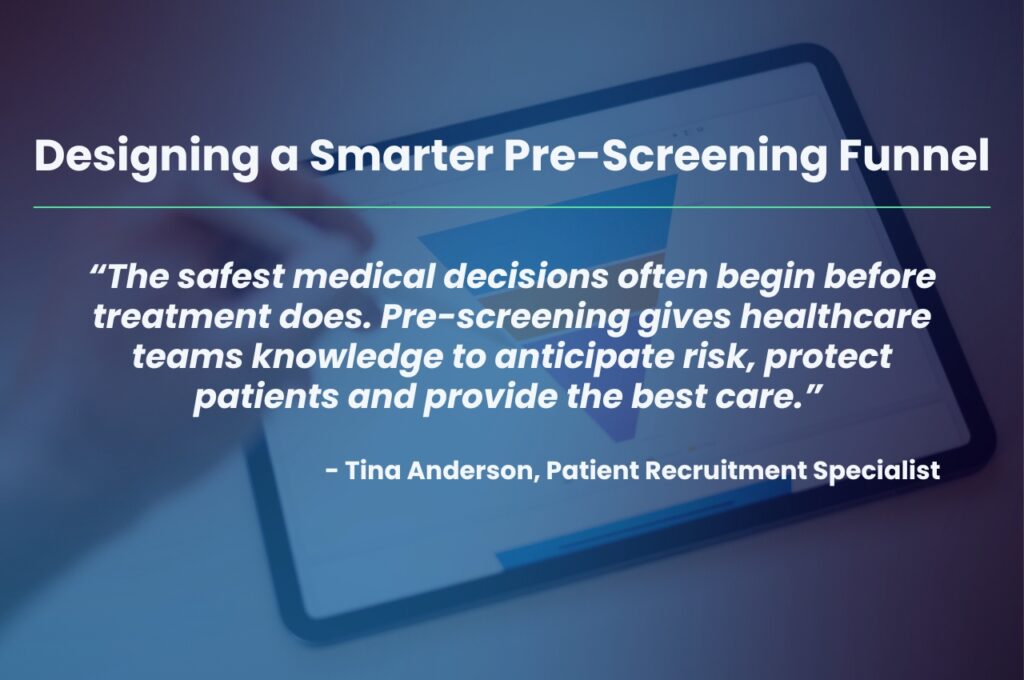
Designing a Smarter Pre-Screening Funnel
Improving pre-screening does not require an entirely new infrastructure, but rather, strategic restructuring:
Sites can begin by identifying which eligibility criteria most frequently produce a screen failure, then moving those specific questions as early into the process as the available information allows. A documented exclusionary diagnosis, a prohibited medication class, or a prior procedure noted in an existing chart does not require a research visit for identification; all you need is someone reviewing the chart prior to scheduling. Essentially, structuring pre-screening around a short, prioritized list of the most disqualifying criteria, rather than treating it as a general eligibility overview, is what seperates pre-screening that meaningfully reduces screen failure from pre-screening that simply adds a step.
The LIFT Diabetes example applies here; since the trial used EHR data to narrow the candidate pool before outreach even began, personnel time was concentrated on candidates who had already cleared the criteria most likely to disqualify them. The lesson is not that every trial has equivalent EHR access, but that the underlying principle (filtering based on disqualifying criteria) can be adapted to whatever information a site already has on hand.
This is also where the AHEAD findings are worth revisiting: onsite observational pre-screening reduced clinical exclusions, but increased biomarker-related failures. Read one way, that looks like pre-screening simply moved the failure elsewhere. In reality, it suggests that pre-screening is only as effective as its match to the criteria actually driving failure in a given protocol. A neurology trial with a high biomarker failure rate needs a different pre-screening emphasis than a trial where failures cluster around concomitant medications or comorbidities. Consequently, the design question is not “how much pre-screening,” but “pre-screening against what specific criteria.”
Screening failure will never reach zero, but high failure rates driven by funnel design are not something to simply accept. Prioritizing how and what to utilize when pre-screening potential patients through your funnel makes all the difference; particularly over numerical volume. That makes the difference between struggling sites, and high-performing ones, such as the ones we frequently support and work with.


No comment yet, add your voice below!