
How Clinical Trials Protect Patients During Research
Consider yourself as a research coordinator, a recruitment specialist, a study nurse; any position where you enroll potential participants for a clinical trial. When reaching out to patients from marginalized communities, despite a higher volume of calls and a targeted approach into enrollment, you experience a disproportionate amount of rejections or ignored responses to your attempted outreach. You may wonder;
Why does patient enrollment decrease when contacting underrrepresented and impoverished communities?
Clinical research’s history, unfortunately, sometimes come at the expense of some of these same communities. The Tuskegee Syphilis Study, for example, withheld appropriate treatment from African American men with syphilis while researchers observed the progression of the disease. Utilization of Henrietta Lacks’ cells without her knowledge or consent, further demonstrated how research practices disregarded individual autonomy and informed consent. As a result, the exploitation of participants was rampant, their protections were non-existent, and members from these same marginalized communities developed apprehension and distrust. In that regard, how can one begin to bridge this gap?
Fortunately, times have changed, and clinical research today has multiple systems designed specifically to protect patients, ensure ethical research, and make sure participation is informed and voluntary. Therefore, building trust requires informing participants about these new systems. To those not within clinical research, and having listened to repeated phrases and empty promises, they wonder:
What protections are actually in place for research participants today, and how are research institutions continuing to improve them?
What is Good Clinical Practice (GCP)?
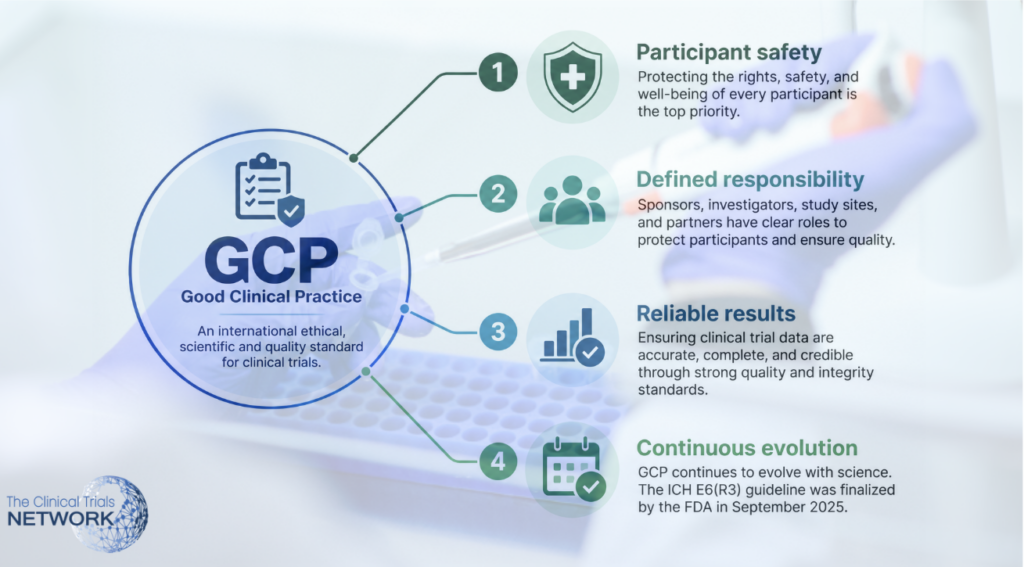
One of the most important protections in modern clinical research begins with Good Clinical Practice, otherwise known as GCP, which establishes an international ethical, scientific, and quality standard for how clinical trials involving human participants should be designed and conducted. At its core, the standard is built around two priorities: protecting the rights, safety, and well-being of participants; and ensuring that the results produced by clinical trials are reliable.
Importantly, GCP has continued to evolve alongside clinical research itself. In September 2025, the FDA finalized ICH E6(R3), the newest revision of the GCP guideline. The update reflects how different clinical trials look today compared with those conducted even a decade or two ago, particularly as technology, decentralized research, electronic data systems, and increasingly complex trial designs become more common.
One of the biggest changes is a greater emphasis on quality by design. Rather than waiting for a problem to occur and correcting it afterward, E6(R3) encourages sponsors and investigators to identify the factors most important to participant safety and reliable trial results before and throughout a study. Oversight can then be focused on the risks that matter most. The result is a more proactive approach to research quality, where participant protection is considered throughout the lifecycle of a clinical trial rather than treated as a box that must be checked before it begins.
This also establishes responsibility across the research process. Sponsors, investigators, sites, and other parties involved in conducting a study have defined responsibilities for maintaining appropriate oversight and protecting participants. As clinical trials continue to change, GCP provides a framework that can change with them without losing sight of the person at the center of the research.
Who Actually Oversees the Ethics of a Clinical Trial?
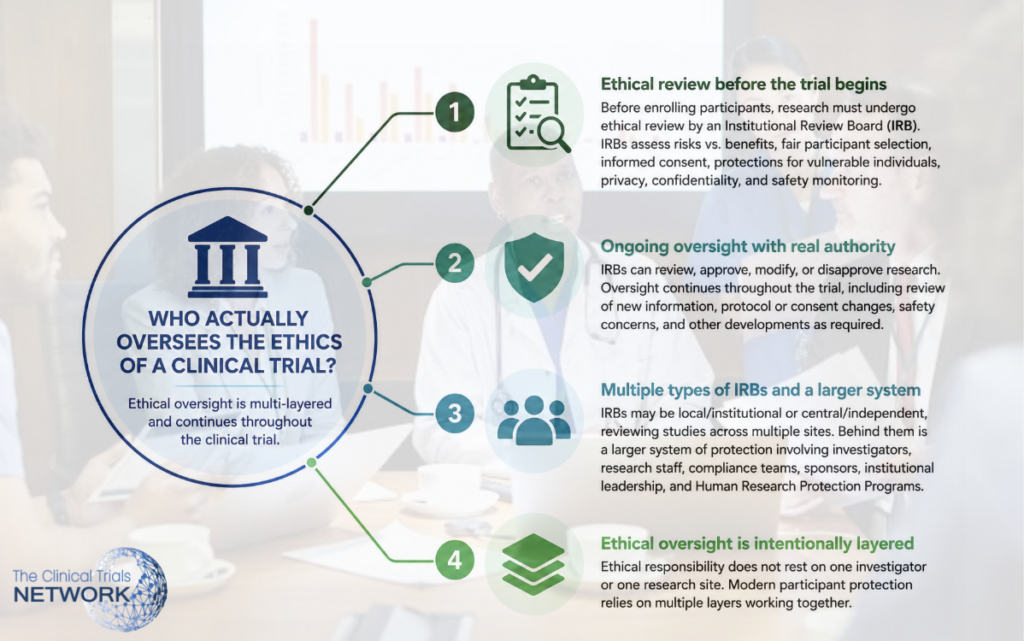
GCP establishes the standard, but it is not the only layer of protection. Before a clinical trial can begin enrolling participants, the research itself must undergo ethical review.
This is where Institutional Review Boards, or IRBs, come in. An IRB reviews whether the potential risks of a study are reasonable in relation to its anticipated benefits, whether participants are being selected equitably, whether informed consent is appropriately obtained, and whether additional protections are necessary for participants who may be vulnerable to coercion or undue influence. IRBs also evaluate provisions for participant privacy, confidentiality, and safety monitoring.
Their authority is meaningful. At institutions such as Mayo Clinic, for example, the IRB has the authority to review, approve, modify, or disapprove research involving human participants. More importantly, ethical oversight does not necessarily disappear once the first participant enrolls. Depending on the study and applicable requirements, IRBs may review new information, changes to the protocol or consent materials, safety concerns, and other developments that could affect participants. Federal guidance also provides for continuing review when required, with the frequency of that review reflecting factors such as the risks of the research and vulnerability of the study population.
Not every IRB operates in exactly the same way. Major research institutions may maintain their own institutional IRBs, while multicenter studies may rely on a central or independent IRB to provide review across multiple participating research sites. Behind the IRB is an even larger system of human research protection involving investigators, research staff, compliance teams, sponsors, institutional leadership, and Human Research Protection Programs.
The important distinction is that ethical oversight is not supposed to rest on the judgment of one investigator or one research site. Modern participant protection is intentionally layered.
What is Informed Consent?
On paper, informed consent can appear relatively straightforward: explain the study, provide the consent form, answer questions, and obtain the participant’s signature. From this pipeline, it appears that informed consent was successfully gathered. Ethically, however, the standard should be much higher.
The real question is not, “Did the participant sign the form?” but rather, “Did this person understand what they were agreeing to?”
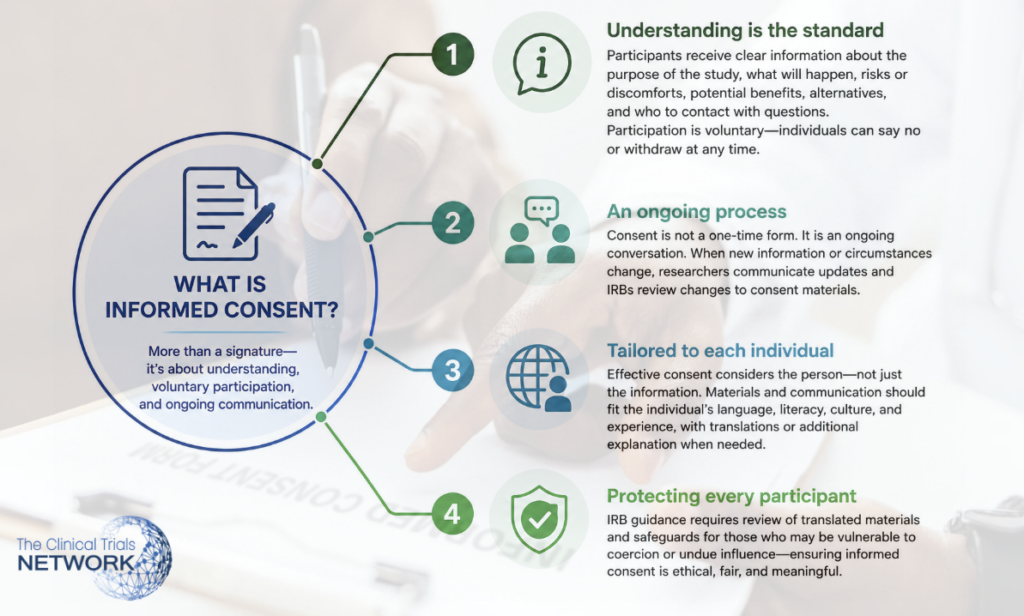
Before agreeing to participate, individuals need sufficient information to understand why the research is being conducted, what will happen during the study, the reasonably foreseeable risks or discomforts, potential benefits, available alternatives, and whom they can contact with questions. Just as importantly, participation must be voluntary. A participant can decline to participate, and enrolling in a clinical trial does not eliminate the ability to later withdraw from it.
Consent should therefore be viewed as an ongoing process of communication, not simply a singular milestone/document completed during the first study visit. When circumstances or information relevant to participation change, researchers may need to communicate those developments to participants. IRB procedures can also require review of changes to consent materials and consideration of whether previously approved consent information needs to be revised.
This becomes particularly important when the same information is being communicated to people with very different backgrounds. A lengthy consent document may technically contain everything required while still failing to communicate effectively to someone with limited health literacy. A participant who speaks another language may require translated materials or interpretation. Someone unfamiliar with clinical research may need additional explanation of concepts that research professionals encounter every day.
Ethically collected informed consent therefore requires researchers to consider the person receiving the information, not simply the information being delivered. Federal IRB guidance specifically addresses procedures for reviewing translated consent materials for non-English-speaking participants and additional safeguards where participants may be vulnerable to coercion or undue influence.
That distinction matters for rebuilding trust. Participants should not merely be given the opportunity to sign a consent form, but a meaningful opportunity to understand it.
How are Ethics Boards Addressing Underserved/Impoverished Communities?
Ethical research is commonly discussed in terms of what happens after someone enters a clinical trial. However, what happens when research design makes participation unnecessarily difficult for participation? This creates an important ethical consideration, for fair participant selection is not about only preventing inappropriate inclusion in research, but examining unnecessary exclusion:
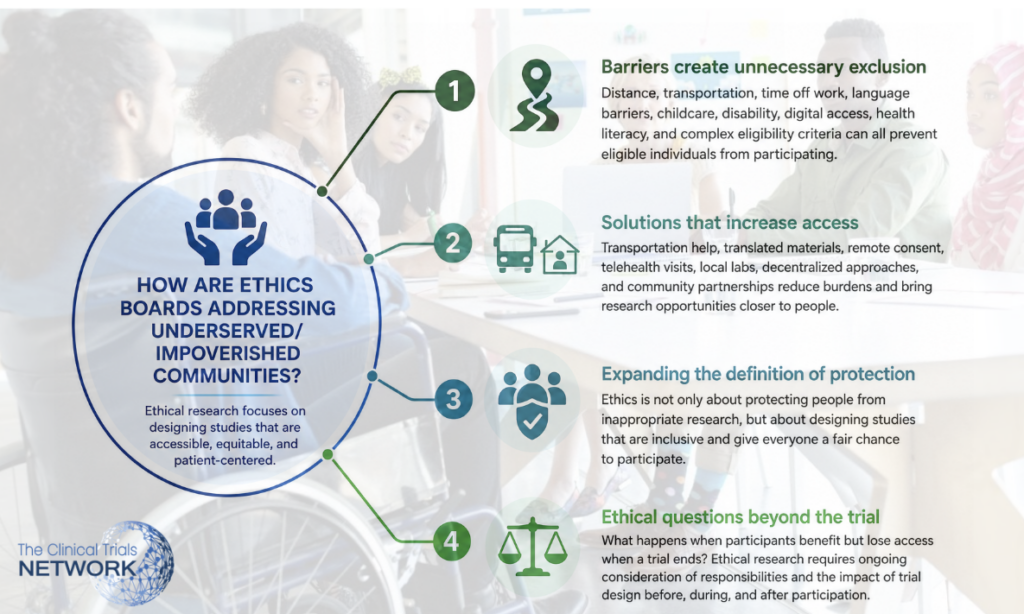
A patient may be perfectly eligible for a study and still be unable to participate because the research site is hours away. Another may not have reliable transportation. Someone working an hourly job may be unable to repeatedly miss work for study visits. Language barriers, childcare responsibilities, disability, digital access, health literacy, and complicated eligibility criteria can all influence whether a theoretical opportunity to participate is actually accessible.
In practice, addressing these barriers can take many forms. Transportation assistance can reduce the burden of traveling to study visits. Translated and literacy-sensitive materials can make research information more understandable. Remote consent, telehealth visits, local laboratory testing, and other decentralized approaches can reduce the number of times a participant must travel to a traditional research site. Community partnerships can also bring information about research into places where patients already receive care and from individuals they already trust.
This expands the definition of participant protection. Ethics is not only about protecting people from inappropriate research, but about designing appropriate research that people have a fair opportunity to access.
There is another ethical question that extends beyond enrollment. What happens when a participant benefits from an investigational treatment, but loses access when the trial ends? What responsibilities exist when participation creates a meaningful benefit that cannot simply continue after the protocol is complete? These questions do not always have simple answers, nor should they. Ethical research requires continued consideration of how trial design affects participants before, during, and potentially after their participation.
What is the Latest Research regarding Ethics in Clinical Practice?
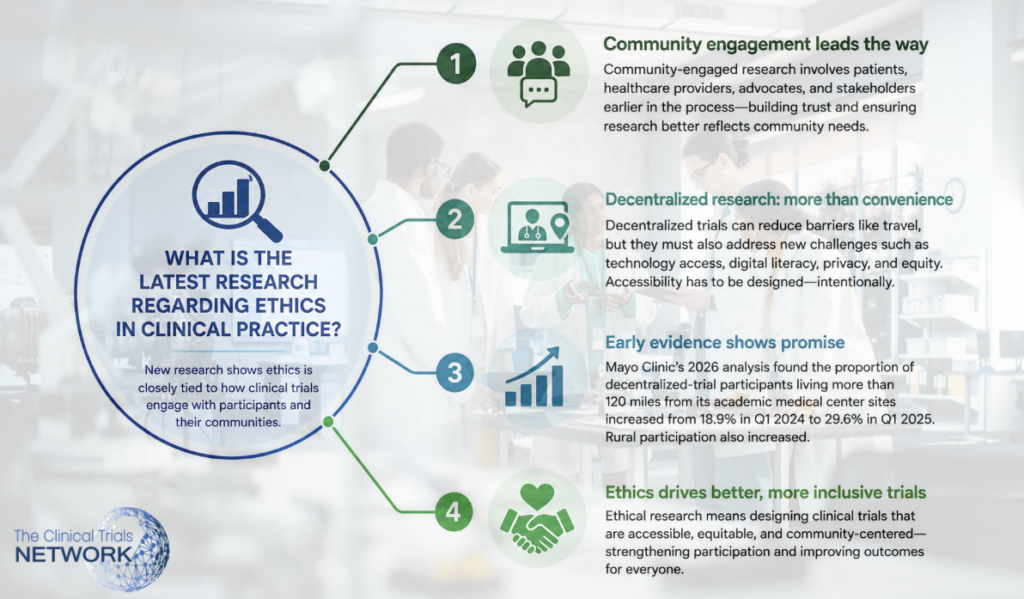
Current research suggests that improving research ethics is increasingly connected to improving the way clinical trials interact with participants and their communities. One area receiving significant attention is community engagement. Rather than developing a trial, and only approaching a community when participants are needed, community-engaged research brings patients, healthcare providers, advocates, and other stakeholders into the conversation earlier. Another growing area is decentralized research; simply labeling a trial “decentralized” does not automatically make it diverse, or equitable. Removing travel requirements can eliminate one barrier, while technology requirements, digital literacy, privacy concerns, or other factors potentially create new ones. In other words, accessibility itself has to be designed. Intentionally.
The early real-world evidence is nevertheless encouraging. Mayo Clinic’s 2026 decentralized trial analysis found that the proportion of decentralized-trial participants living more than 120 miles from one of its academic medical center sites increased from 18.9% in the first quarter of 2024, to 29.6% in the first quarter of 2025. Rural participation also increased over the observed period.
So, let’s face the original scenario: When trying to enroll patients into a research study, how can one bridge the gap between concerned citizens and future participants? What needs to change?
Simply put, posture. The realm of clinical research must stop demanding enrollment and start earning curiosity through accurately conveyed information. A conversation only works if it moves in both directions, and as it turns out, so does a clinical trial.





No comment yet, add your voice below!